RSD and ADHD: They are more related than you think.
Rejection sensitive dysphoria, or RSD, describes intense emotional pain tied to perceived rejection or criticism and is frequently discussed in relation to attention deficit hyperactivity disorder, or ADHD.
This article defines RSD, explains how it commonly overlaps with ADHD and emotion dysregulation, and outlines signs, emotional responses, and everyday triggers people report. It reviews treatment approaches that clinicians may use for co-occurring mental health conditions, including medications that treat ADHD or mood disorders and psychotherapy approaches such as cognitive behavioral therapy, acceptance and commitment therapy, and mindfulness-based therapy.
Struggling with focus, impulsivity, or maintaining relationships due to ADHD? Southern California Sunrise Mental Health Center offers personalized treatment plans designed for adults. Call (844) 543-2563 today to take the first step toward managing your symptoms.
What Is Rejection Sensitive Dysphoria (RSD)?
Rejection sensitive dysphoria (RSD) refers to sudden, intense emotional pain following perceived rejection, criticism, or social failure, sometimes labeled more broadly as rejection sensitivity dysphoria.
People experiencing RSD often report rapid emotional responses such as shame, rage, or profound withdrawal that can feel disproportionate to the triggering event and may include physical symptoms such as heart racing, nausea, sweating, or changes in blood pressure.
RSD is a descriptive term used in clinical practice and research rather than a formal psychiatric diagnosis, and understanding it as a pattern of emotion dysregulation can help guide assessment and support for overlapping mental health conditions such as social anxiety or depression. Experts estimate that up to 99% of people with ADHD will experience RSD in their lifetime.
Neuroscience research suggests that brain structure and function in areas like the frontal lobe, prefrontal cortex, and frontal cortex may influence stress response, impulse control, and sensitivity to social cues. Understanding RSD as an emotional-reactivity pattern linked to these brain systems clarifies why it frequently appears in discussions about ADHD and related treatment choices.
Don’t let ADHD hold you back from reaching your full potential at work or in your personal life. Our experienced team at Southern California Sunrise Mental Health Center is here to help. Contact us at (844) 543-2563 or learn more about our ADHD treatment options.
How RSD and ADHD are Related
Many clinicians and people with ADHD note that RSD is commonly reported among individuals with ADHD, though not everyone with ADHD experiences it.
Shared features that may link the two include difficulties with emotional regulation, impulsivity, automatic thought patterns that assume rejection, and heightened sensitivity to social interactions and feedback.
Addressing underlying ADHD symptoms can reduce overall emotional reactivity for some people, while targeted strategies for emotion regulation can directly reduce RSD-related distress and social anxiety.
Seeing the overlap between RSD and ADHD makes it easier to identify practical signs, understand social phobia or performance fears that can develop, and notice typical triggers in daily life.
Common RSD Signs and ADHD-Related Triggers
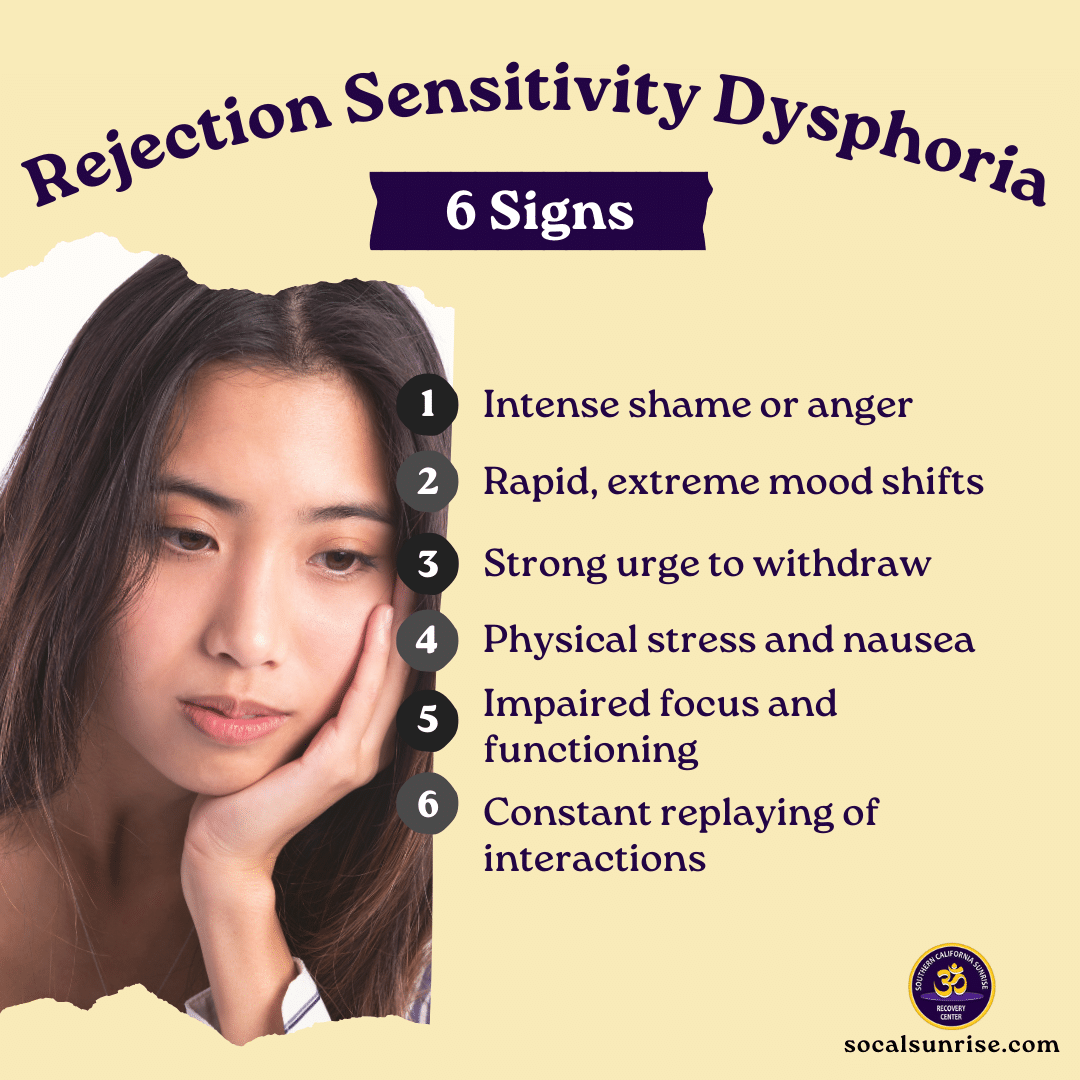
Do you have RSD? Here are some common signs of rejection sensitive dysphoria, plus what triggers them:
Common signs
- Intense shame, humiliation, or sudden anger after perceived criticism in social interactions
- Quick shifts from calm to extreme distress or irritability in response to subtle cues
- Strong urge to withdraw, avoid, or overcompensate to prevent rejection or social anxiety
- Rumination, replaying interactions for hours or days and focusing on automatic thought patterns
- Physical symptoms such as heart palpitations, nausea, sweating, or changes in blood pressure
- Impaired concentration or functioning after an episode, especially in school or work settings
Common triggers
- Direct criticism, corrective feedback, or performance reviews
- Ambiguous social cues such as delayed text replies, unread messages, or brief responses
- Social rejection, breakups, social phobia situations, or exclusion from a group
- Public mistakes or perceived failure in work, school, or other social interactions
Recognizing these patterns supports targeted treatment planning that often combines clinical care, practical coping skills, and peer or professional support groups. Mental health issues left untreated can interfere with daily life, like school, work, and relationships.
RSD and ADHD Treatment Options and Clinical Approaches
There is no single treatment universally recommended for RSD because it is not a formal diagnosis; care is individualized based on symptoms, comorbid conditions, and functional impact.
Clinicians typically treat the most impairing symptoms first, often addressing ADHD and mood disorders or anxiety disorders if they are present.
A combined approach of medication when appropriate and psychotherapy or skills training often gives the best opportunity to reduce the frequency and intensity of episodes and improve overall stress response.
Ready to regain control and improve your daily functioning? Southern California Sunrise Mental Health Center provides evidence-based ADHD treatment tailored to your unique needs. Reach out to our compassionate experts to start your journey toward better focus and well-being.
Medications Clinicians Might Consider for RSD and ADHD
No medication is approved specifically for RSD, but clinicians may prescribe medications that address ADHD, mood lability, anxiety, or depression, depending on each person’s needs.
Depending on clinical judgment, a healthcare provider may consider:
- Stimulant medications commonly used for ADHD, which can reduce distractibility and sometimes decrease emotional reactivity for some people.
- Nonstimulant ADHD options such as atomoxetine or bupropion when stimulants are not suitable.
- Antidepressants such as selective serotonin reuptake inhibitors (SSRIs), serotonin–norepinephrine reuptake inhibitors (SNRIs), or, less commonly, a Monoamine oxidase inhibitor in carefully monitored situations, especially for treatment-resistant mood disorders.
Medication decisions are individualized and require monitoring for benefit, side effects, and safety, with no promise of complete elimination of RSD experiences.
Psychotherapy and Skills-Based Treatments for RSD and ADHD
Several therapies can help manage the thoughts, emotions, and behaviors linked to RSD, ADHD, and related mental health conditions. Approaches may include:
- Cognitive behavioral therapy (CBT) to identify unhelpful automatic thought patterns, challenge assumptions of rejection, and build coping strategies.
- Acceptance and commitment therapy (ACT) to support distress tolerance and values-based action, even when difficult emotional responses arise.
- Dialectical behavior therapy (DBT) and other emotion regulation skills training to help manage intense emotions, improve interpersonal effectiveness, and reduce social anxiety or social phobia.
- Mindfulness-based therapy to increase awareness of internal experiences, reduce reactivity to stress, and support a calmer stress response.
- ADHD coaching and skills training to reduce triggers tied to executive-function challenges, organization, and planning.
Psychotherapy often works best when combined with medical treatment when appropriate, supported by peer or clinician-led support groups, and practiced consistently over time.
Living with adult ADHD doesn’t have to mean constant struggle. At Southern California Sunrise Mental Health Center, we understand the challenges you face and offer effective solutions. Call (844) 543-2563 now to schedule a consultation and discover how we can support your path to success.
Practical Coping Strategies for RSD and ADHD
Here are some practical, daily coping strategies if you struggle with RSD and ADHD:
- Pause before reacting: practice a brief grounding technique such as slow breathing or a short mindfulness exercise to reduce impulsive responses and modulate the stress response.
- Prepare short response scripts for feedback or difficult conversations to reduce rumination and fear of social interactions.
- Use self-compassion and reality-testing: check whether evidence supports the perceived rejection or whether an automatic thought is exaggerating social risk.
- Set boundaries and clarify expectations with colleagues and loved ones to reduce ambiguous social cues that may trigger social anxiety.
- Maintain routine sleep, physical activity, and nutrition to support emotional resilience and brain structure and function, especially in regions such as the frontal lobe and prefrontal cortex.
Practical strategies can reduce immediate distress and improve confidence in handling situations that once felt overwhelming, including challenging social interactions or performance situations.
Accommodations for Students and Employees with ADHD and RSD
For some people with ADHD and RSD, reasonable accommodations at school or work can reduce triggers and improve performance. Possible accommodations include:
- Private or written feedback instead of public criticism to reduce social anxiety and social phobia.
- Flexible deadlines or task prioritization support to account for emotional responses and attentional challenges.
- Quiet workspace or reduced sensory distractions to support focus and reduce stress response.
- Clear, written instructions and regular check-ins to minimize misunderstandings in social interactions.
- Extended time for exams or assignments when attention, anxiety, or mood disorders interfere.
When requesting accommodations, document functional limitations, propose specific reasonable adjustments, and work with disability services, HR, or a treating healthcare provider to provide supporting documentation.
Framing requests around concrete tasks and outcomes can help employers or schools implement practical supports consistently.
Using accommodations consistently can reduce exposure to common triggers and improve functioning in work or school settings, especially when combined with therapy and support groups.
When RSD and ADHD Distress Require Urgent or Emergency Help
RSD-related distress sometimes coincides with severe anxiety, depression, or suicidal thoughts, and safety always comes first. Seek immediate help if you or someone else is at imminent risk of harming themselves or others, has active suicidal thoughts with a plan or intent, is unable to care for basic needs, or experiences severe panic or psychotic symptoms.
In the United States, you can call or text 988 to reach the Suicide & Crisis Lifeline, or contact local emergency services or go to the nearest emergency department; the National Suicide Prevention Lifeline name is still commonly recognized, though 988 is now the primary number.
For less acute but still serious concerns, contact your treating clinician, a crisis team, or a trusted support person to make a safety plan and consider connecting with local or online support groups.
When distress reaches the level of safety risk, prompt professional help can be lifesaving, and clinicians can assist with both immediate stabilization and ongoing care planning.
Get help for RSD and ADHD-related challenges
If RSD-like reactions are affecting your daily life, consider reaching out to a mental health professional or primary care clinician who understands ADHD, emotion regulation, and related mental health conditions so you can get a personalized plan for safety and symptom management.
If ADHD symptoms are impacting your quality of life, help is available. Southern California Sunrise Mental Health Center specializes in adult ADHD treatment with proven results. Take action today—explore our ADHD treatment service options.
RSD and ADHD: FAQ
Is rejection sensitive dysphoria (RSD) an official psychiatric diagnosis?
RSD is not a formal psychiatric diagnosis listed in the Diagnostic and Statistical Manual of Mental Disorders (DSM-5). It is a descriptive term clinicians and researchers use to describe intense emotional reactions to perceived rejection or criticism. Because it is not an official diagnosis, assessment focuses on the specific symptoms, functional impact, and any comorbid conditions such as ADHD, social anxiety, or mood disorders.
How is RSD different from ordinary sensitivity to criticism?
RSD differs in intensity, speed of onset, duration, and functional impact. Ordinary sensitivity may cause brief hurt or self-reflection, while RSD involves rapid escalation to intense shame, rage, or withdrawal that can impair daily functioning and lead to avoidance, social phobia, or disproportionate responses. The degree of emotion dysregulation and the frequency of strong reactions distinguish RSD-like experiences from normal sensitivity.
Is RSD contagious or something you can “catch” from others?
No, RSD is not contagious. Emotional reactions to perceived rejection develop from a person’s history, temperament, brain structure and function, and neurobiology rather than by direct transmission. However, being around highly critical or invalidating people can increase the likelihood of triggering someone who is already sensitive, so environment and relationships can influence how often episodes occur.
Can RSD be genetic or hereditary?
There is no single “RSD gene.” Traits related to emotional reactivity and ADHD have genetic components, and family patterns of sensitivity or emotion regulation difficulties are often reported. Genetics can contribute to vulnerability, but environment, life experiences, and learned responses also shape how rejection sensitivity presents over time.
How long do RSD episodes last, and is RSD lifelong?
Episode length varies widely. Some episodes are brief, lasting minutes, while others involve extended rumination and mood changes lasting hours or days. RSD-like patterns can persist over time, but they are often responsive to treatment, skills training, environmental changes, and participation in supportive communities or support groups.
Which medications might clinicians consider when RSD symptoms appear with ADHD?
No medication is approved specifically for RSD, but clinicians commonly consider treatments that address ADHD, mood, or anxiety symptoms. Options may include stimulant or nonstimulant ADHD medications, bupropion, SSRIs or SNRIs for comorbid anxiety or depression, and alpha agonist medications such as alpha-2 receptor agonists like guanfacine for emotional dysregulation; in limited situations, a Monoamine oxidase inhibitor may be considered by a specialist for difficult-to-treat mood disorders. Medication selection is individualized and requires discussion of potential benefits, risks, and blood pressure or other safety considerations with a prescriber.
Can psychotherapy such as CBT or ACT help manage RSD?
Yes, psychotherapy approaches such as cognitive behavioral therapy and acceptance and commitment therapy can help by changing unhelpful automatic thought patterns, increasing distress tolerance, and building values-driven actions. Therapies that teach emotion regulation, mindfulness-based strategies, interpersonal effectiveness, and skills for social interactions are often helpful and can be combined with medication and practical supports.
Are there validated screening tools clinicians use specifically for RSD?
There are no universally accepted clinical screening tools created solely for RSD. Research tools such as the Rejection Sensitivity Questionnaire (RSQ) and related scales measure rejection sensitivity in research settings. Clinicians more commonly use assessments for ADHD, mood, anxiety, social anxiety or social phobia, and broader measures of emotion dysregulation to evaluate underlying contributors.
How can students or employees with ADHD/RSD request accommodations effectively?
Document how symptoms affect specific job or school tasks, including concentration, emotional responses, and social interactions, and propose concrete reasonable accommodations. Contact your employer’s HR department or your school’s disability services, obtain a letter from a treating healthcare provider that describes functional limitations and recommended accommodations, and be prepared to discuss trialing adjustments. Framing requests around clear tasks and measurable outcomes helps decision-makers implement practical supports.
When should I seek emergency help for RSD-related distress or suicidal thoughts?
Seek emergency help if you have current intent or a plan to harm yourself or others, cannot care for yourself, or feel unable to stay safe. Call local emergency services, go to the nearest emergency department, or call or text 988 in the United States to reach the Suicide & Crisis Lifeline (formerly associated with the National Suicide Prevention Lifeline number). If you are not in immediate danger but are experiencing severe or escalating symptoms, contact your treating clinician, a crisis line, or a trusted support person for help creating a safety plan and consider connecting with support groups.