What are the 4 types of OCD? The 4 main types of OCD include Contamination/Cleaning, Symmetry/Ordering, Forbidden Thoughts, and Checking/Harm. OCD is a mental health condition characterized by unwanted intrusive thoughts and repetitive behaviors aimed at reducing distress.
This article defines OCD in plain terms and explains the four main types of OCD: contamination, checking, symmetry, and intrusive thoughts. You’ll learn about typical symptoms and compulsions for each type of OCD, how mental contamination differs from physical contamination, evidence-based treatments like exposure and response prevention (ERP), Cognitive Behavioural Therapy (CBT), and medication options, plus practical next steps for seeking care.
Does OCD feel like it’s controlling your life? You don’t have to manage these intrusive thoughts and compulsive behaviors alone. Southern California Sunrise Mental Health specializes in evidence-based OCD treatment designed to help you regain control.
What is Obsessive-Compulsive Disorder?
Obsessive-compulsive disorder is one of several mental health disorders characterized by obsessions—intrusive, unwanted thoughts, images, or urges that cause distress—and compulsions, which are repetitive actions or mental compulsions intended to reduce that distress.
Research by the National Institute of Mental Health shows that brain functions related to decision-making and anxiety regulation play a role in OCD. Risk factors include family history and stressful life events, though OCD can develop in anyone.
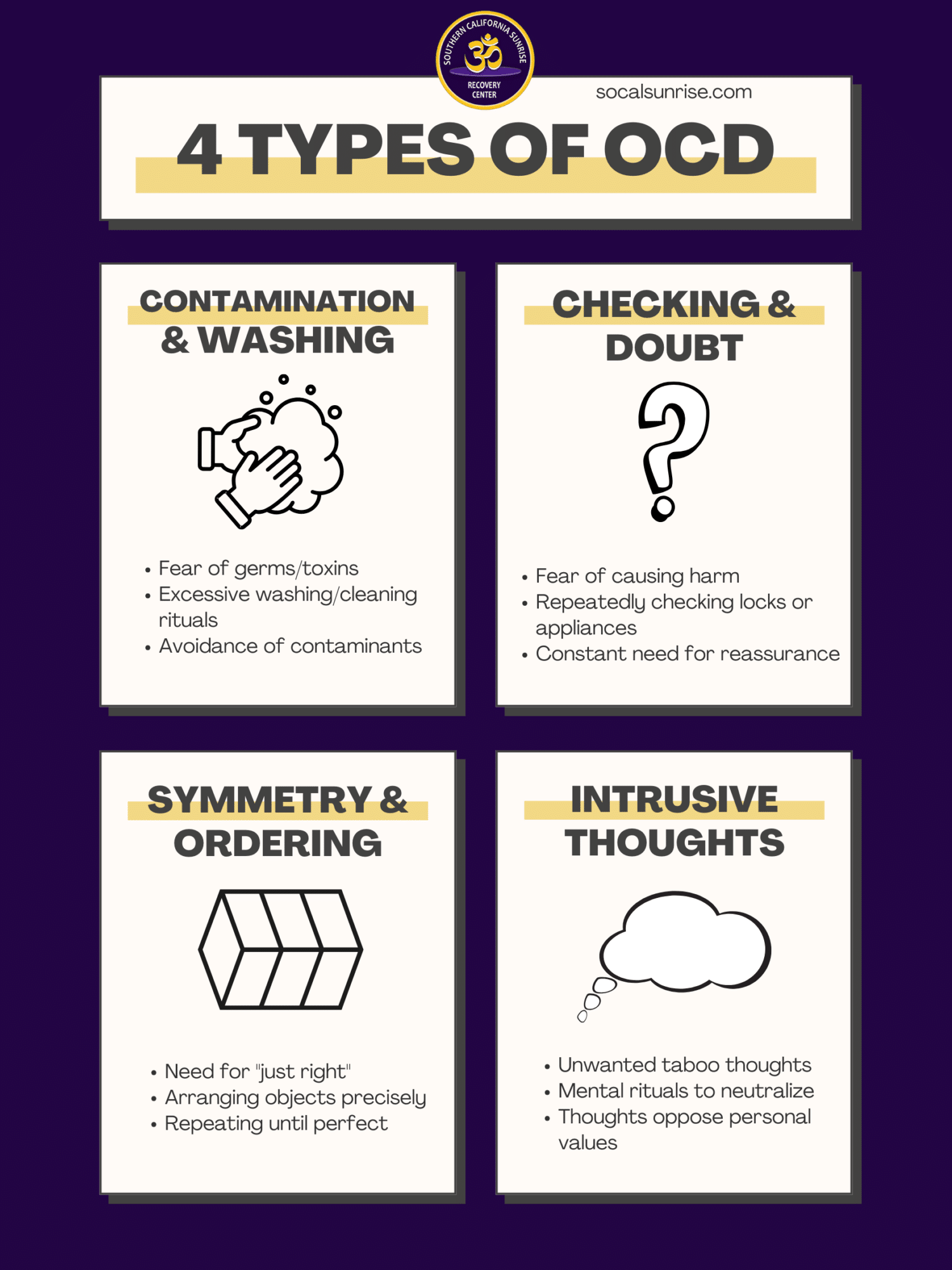
The Four Main Types of OCD
When learning about types of OCD, it’s helpful to know that these types are common patterns clinicians and researchers use to describe clusters of obsessions and compulsions. Understanding the different types of OCD helps guide assessment and treatment planning tailored to your specific symptoms.
1. Contamination and Washing OCD
This type of OCD, sometimes called contamination and cleaning OCD, involves fears of germs, illness, toxins, or perceived impurity, leading to avoidance and repeated washing or cleaning behaviors. Common compulsions include:
- Excessive hand washing or showering (sometimes to the point of contact dermatitis)
- Repeated laundering of clothes or linens
- Avoiding certain places, objects, or people
- Ritualized cleaning routines
- Checking or seeking reassurance about whether surfaces are clean
People with contamination OCD often experience significant time loss and distress while trying to prevent perceived harm.
Mental Contamination vs. Physical Contamination:
Mental contamination refers to feeling “dirty” or morally tainted after a thought, image, or interaction, even when there’s no physical substance involved. This can involve magical thinking—the belief that thoughts or actions can influence outcomes in illogical ways. Unlike physical contamination fears that lead to cleaning behaviors aimed at removing actual germs or dirt, mental contamination often triggers internal rituals such as:
- Repeated apologies
- Mental reviewing
- Seeking forgiveness
- Avoidance of people or situations linked to the feeling
Understanding this distinction between types of contamination OCD helps shape effective exposure work and cognitive approaches in treatment.
2. Checking and Doubt OCD
This type of OCD, also called Checking OCD, centers on fears of having caused harm, made a mistake, or missed something important. A related form is Harm OCD, where intrusive thoughts about accidentally or intentionally causing harm to oneself or others trigger intense anxiety and checking behaviors. Common compulsions include:
- Rechecking locks, appliances, or switches
- Reviewing medical orders or work tasks repeatedly
- Mentally reviewing conversations and decisions
- Seeking repeated reassurance from others
The checking provides temporary anxiety relief but often increases long-term distress and reinforces the cycle of doubt.
3. Symmetry, Ordering, and “Just Right” OCD
This type of OCD, sometimes referred to as Symmetry and Ordering OCD or order and symmetry OCD, involves a strong need for things to feel “just right,” neatly arranged, or balanced. Compulsions include:
- Arranging or ordering objects in specific ways
- Counting or repeating actions until they feel correct
- Slow, precise behaviors to achieve an inner sense of completeness
- Straightening, aligning, or organizing repeatedly
Distress arises when items are out of order or when internal sensations don’t match expectations. This type of OCD can be particularly time-consuming and interfere significantly with daily functioning.
4. Intrusive or Taboo Thoughts OCD
This type of OCD, also known as Intrusive Thoughts OCD, involves unwanted images or ideas involving themes such as aggression, sexual content, blasphemy, or unacceptable impulses. One specific subtype is scrupulosity OCD, which centers on religious or moral fears and excessive worry about committing sins or moral violations. These thoughts are ego-dystonic, meaning they oppose the person’s values or identity. Common compulsions include:
- Mental rituals to neutralize or “undo” thoughts
- Excessive praying or mental reviewing
- Checking memories to disprove the thought
- Avoidance of triggers associated with the thoughts
Understanding that these intrusive thoughts don’t reflect your character is an important step toward effective treatment.
Ready to take the first step toward freedom from OCD? Southern California Sunrise Mental Health provides specialized treatment programs that address the root causes of obsessive-compulsive disorder, not just the symptoms. Contact our compassionate team in Orange County to learn more about our individualized care plans.
Can You Have Multiple Types of OCD?
Yes. Each type of OCD can look different from person to person, and many people experience overlapping types of OCD or shift between them over time. Treatment focuses on managing distress and changing responses rather than labeling someone by a single type.
Related Conditions and Dual Diagnosis OCD
OCD often occurs alongside other mental health disorders in what’s called dual diagnosis. Related conditions include:
- Body dysmorphic disorder (BDD)
- Hoarding disorder (sometimes called Hoarding OCD when symptoms overlap)
- Skin picking disorder
- Depression and anxiety disorders
- Tic disorders
These coexisting conditions can influence treatment choices and require integrated care approaches.
Evidence-Based Treatment Approaches for All Types of OCD
The most strongly supported treatments for OCD work effectively across all types:
Exposure and Response Prevention (ERP) for OCD
This specialized form of exposure therapy involves gradual, guided exposure to feared situations or thoughts while refraining from the usual compulsive response. Evidence suggests ERP can reduce symptoms for many people across all types of OCD.
Cognitive Behavioral Therapy (CBT) for OCD
CBT helps identify and shift unhelpful beliefs and responses to obsessions, supporting ERP work and addressing the thought patterns that maintain OCD symptoms. Many people benefit from online therapy options that provide access to CBT and ERP with trained specialists.
Medication for OCD
Selective serotonin reuptake inhibitors (SSRIs), prescribed and monitored by a clinician, may reduce symptom severity for some people across different types of OCD. Combining psychotherapy and medication is sometimes recommended based on individual needs.
Additional OCD Treatment Options:
For treatment-resistant cases, specialized interventions may include:
- Transcranial magnetic stimulation (TMS): A non-invasive procedure that uses magnetic fields to stimulate brain regions.
- Deep Brain Stimulation (DBS): A surgical option for severe, treatment-resistant OCD.
- Complementary Lifestyle Approaches: Mindfulness techniques and mindfulness practices or grounding exercises for managing anxiety.
- Support Groups: online support groups through organizations like the International OCD Foundation
Treatment is often delivered through outpatient treatment programs, allowing people to maintain daily routines while receiving care. Treatment planning considers your specific type of OCD, symptom patterns, level of insight, coexisting conditions, and life circumstances. A careful assessment helps match approaches to your goals while protecting safety and privacy.
OCD doesn’t improve with time—it requires professional intervention. If obsessive thoughts and compulsive rituals are disrupting your daily life, relationships, or career, Southern California Sunrise Mental Health can help. Our specialized Orange County treatment center has a compassionate team available for psychiatric evaluation and diagnosis.
OCD Types vs. Specifiers: Understanding the Difference
Types of OCD are descriptive themes rather than separate diagnostic categories. Specifiers, on the other hand, are part of formal diagnostic frameworks and describe features such as:
- Insight level (good, fair, poor, or absent)
- Tic-related features
- Developmental or episodic course
People can experience multiple types of OCD simultaneously, and comorbid conditions such as depression, anxiety disorders, or tic disorders are common and can influence treatment choices. Recognizing both types and specifiers informs a more personalized treatment plan.
OCD Symptoms: Practical Next Steps
If obsessions or compulsions are causing significant distress, impairment, or safety concerns, seeking assessment from a licensed mental health professional or primary care provider is a reasonable next step. When looking for care:
- Ask about clinicians trained in exposure and response prevention (ERP) and cognitive behavioral therapy (CBT)
- Inquire about experience treating your specific type of OCD
- Discuss typical treatment length and how progress is measured
- Ask about privacy practices
- Consider online therapy options if in-person care is limited
- Explore support groups through the International OCD Foundation
- If medication is being considered, discuss risks and benefits with a prescribing provider
For immediate safety concerns or risk of harm, contact local emergency services or a crisis line.
Families seeking clarity can benefit from involvement in treatment planning when appropriate. These practical steps support informed decisions and reduce barriers to getting appropriate care for any type of OCD.
Getting Help for OCD Symptoms
Southern California Sunrise Mental Health’s Orange County OCD Treatment Center offers the specialized care you need to overcome obsessive-compulsive disorder. Our expert team provides proven psychotherapies and medication management in a supportive, understanding environment. OCD is treatable—and recovery is possible.
Take action now. Call (844) 543-2563 to speak with an admissions specialist or learn more about our admissions process for OCD residential treatment. Your path to freedom starts here.
Frequently Asked Questions About Types of OCD
Here are some questions people also ask about the different types of OCD:
What are the four main types of OCD?
The four commonly described types of OCD are: contamination and washing, checking and doubt (including Checking OCD and Harm OCD), symmetry and ordering (often described as “just right” experiences), and intrusive or taboo thoughts (including scrupulosity OCD). These types describe common clusters of obsessions and compulsions used to guide assessment and treatment planning.
Are OCD types official diagnoses or just common themes?
Types of OCD are descriptive themes rather than separate official diagnoses. Clinicians use these types to understand symptom patterns, while formal diagnosis follows criteria in diagnostic manuals. The types help tailor treatment but don’t replace a diagnostic assessment.
What symptoms and compulsions characterize contamination/washing OCD?
This type of OCD often includes worries about germs, illness, or contamination. Compulsions commonly include excessive hand washing, showering, cleaning, avoiding perceived contaminants, and ritualized cleaning routines. Avoidance and reassurance seeking may also occur. In severe cases, excessive washing can lead to contact dermatitis.
What is mental contamination and how does it differ from physical contamination?
Mental contamination is a subjective feeling of being dirty or tainted after a thought, memory, or interaction, without a physical contaminant present. It may involve magical thinking about how thoughts can affect reality. Physical contamination involves fear of germs or substances and leads to cleaning behaviors. Mental contamination often requires different therapeutic strategies focusing on emotional processing and cognitive exposure.
What symptoms and compulsions characterize checking/doubt OCD?
This type of OCD, including Checking OCD and Harm OCD, involves persistent doubts about having caused harm or made a mistake, leading to repetitive checking behaviors. Common compulsions include rechecking locks, appliances, medical instructions, and repeatedly reviewing conversations or decisions, along with reassurance seeking.
What symptoms and compulsions characterize symmetry/ordering OCD?
This type of OCD, also called Symmetry and Ordering OCD, centers on the need for things to be arranged or felt in a particular way to achieve an internal sense of correctness. Compulsions include arranging, ordering, counting, or repeating actions until they feel right.
What are intrusive/taboo thoughts in OCD, and what compulsions commonly follow?
This type of OCD, called Intrusive Thoughts OCD, involves unwanted images or impulses involving aggression, sexual content, blasphemy (scrupulosity OCD), or themes that conflict with a person’s values. Compulsions often include mental rituals such as neutralizing thoughts, excessive praying, reviewing memories to disprove the thought, or avoidance.
Can a person experience more than one type of OCD at the same time?
Yes, many people experience multiple types of OCD simultaneously or shift between types over time. Symptoms can overlap and influence one another, which is why assessment looks at the full symptom profile rather than a single label. Dual diagnosis with other mental health disorders is also common.
Are OCD types the same as OCD specifiers?
No, types of OCD refer to thematic clusters of symptoms, while specifiers are formal modifiers clinicians use to describe features such as level of insight, tic-related presentations, or episodic course. Both are useful in treatment planning but serve different roles.
Does my OCD type matter for treatment?
Your type of OCD helps clinicians tailor exposures, select relevant cognitive strategies, and prioritize functional goals. Core evidence-based treatments like ERP and CBT are effective across all types of OCD, but how those treatments are implemented is often adapted to your specific symptoms and individual context. Treatment may be delivered through outpatient treatment programs, online therapy, or complemented by support groups and mindfulness practices.