Attention deficit hyperactivity disorder (ADHD) can make it hard to concentrate, sit still, and tolerate tedious tasks or boredom. For some people, the ongoing strain of managing these symptoms leads them to turn to drugs or alcohol as a way to cope. When ADHD and substance use occur together, they can reinforce one another in a cycle that’s difficult to break without professional, integrated care.
Although ADHD is often diagnosed in childhood, roughly one-third to one-half of people with ADHD continue to experience symptoms into adulthood. [1] It frequently goes undiagnosed in adults, especially those living with another mental health condition. [2]
If you’re an adult with ADHD, you may be more vulnerable to co-occurring substance use — whether from using drugs or alcohol to manage difficult symptoms, or from misuse of stimulant medications prescribed to treat the condition. When ADHD and substance use appear together, treating them as connected, rather than separately, tends to offer the most stable path forward.

ADHD Dual Diagnosis
Individuals with ADHD tend to be overly active, have trouble concentrating, and become bored easily. Oftentimes, people who suffer from ADHD are more likely to develop a substance abuse disorder to cope with the symptoms of ADHD. These disorders combined commonly provoke a cycle of addiction that can be difficult to break without serious treatment.
Table of Contents
Attention deficit hyperactivity disorder (ADHD) is a neurological condition that impacts a person’s ability to concentrate, sit still, and handle tedious tasks or boredom. Although ADHD is often diagnosed in children, about one-third to one-half of ADHD patients will experience symptoms as they grow older.1 ADHD often goes undiagnosed in adults, especially those who have another mental health condition.2
If you are an adult with ADHD, you may be more likely to experience substance abuse. ADHD patients often turn to drugs and alcohol to cope with the symptoms they experience or become addicted to stimulants they receive to treat their condition. Co-occurring ADHD and substance abuse can create a cycle of addiction that can be difficult to break without professional treatment.
Facts and Figures About ADHD
- 52% of children with ADHD had a behavioral or conduct issue
- 33% experienced anxiety
- 17% had symptoms of depression
- 14% had autism spectrum disorder
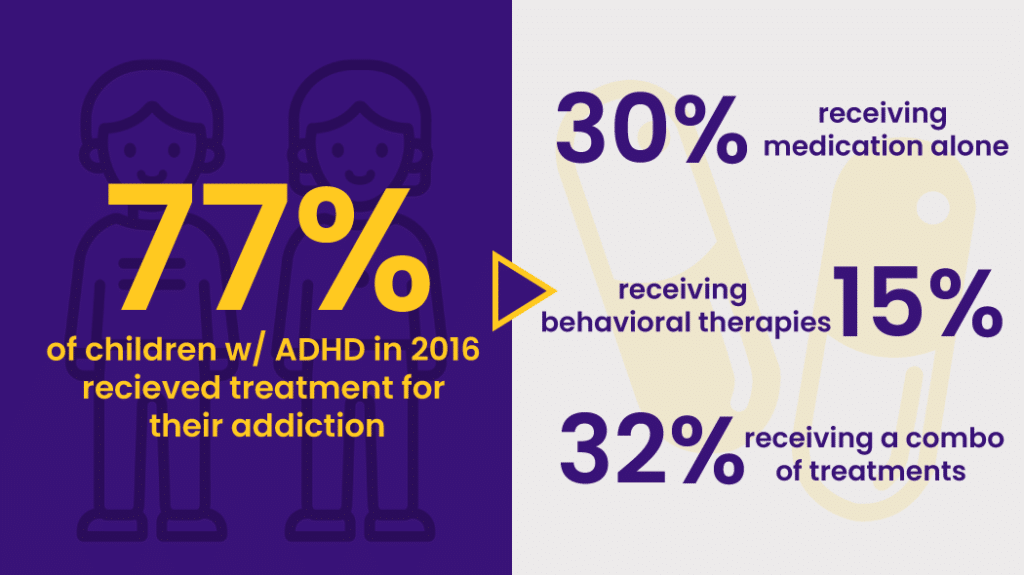
These issues can carry well into adulthood. While there is no cure for ADHD, symptom management is possible. Approximately 77% of children with ADHD in 2016 received treatment for their condition, with 30% receiving medication alone, 15% receiving behavioral therapies, and 32% receiving a combination of treatments.
Related read: RSD and ADHD Signs, Connections, & Treatment
Causes of ADHD
No one knows the exact cause of ADHD. However, there are certain risk factors that may increase a person’s risk of developing the condition.
Family History
Exposure to Lead
Tobacco Use During Pregnancy
ADHD Signs and Symptoms
- Being distracted
- Difficulty organizing tasks and activities
- Failing to pay close attention to details
- Difficulty staying focused during activities
- Difficulty following directions
- Avoiding tasks that require sustained mental focus
- Forgetting to do daily activities
- Fidgeting, tapping, and squirming
- Difficulty staying seated
- Talking too often
- Being in constant motion
- Difficulty accomplishing an activity quietly
- Difficulty waiting for a turn to speak or participate in activities
- Interrupting or intruding on others’ conversations or activities
The Link Between ADHD and Substance Use
School, Work, and Relationship Issues
If you have ADHD, you may experience issues at work or in school. You may be unable to focus on tasks, misplace items you need to complete an assignment, and feel chronically disorganized. You may forget social engagements, obligations, and important dates, leading to interpersonal conflicts.
As a result, ADHD symptoms can strain your relationships and cause issues in your personal and professional life. These aggravating factors can cause ADHD patients to turn to drugs and alcohol to cope with their symptoms.
Dopamine Deficiency
ADHD patients have lower levels of dopamine in their brains, a neurotransmitter responsible for controlling pleasure, focus, and motivation. 10 When you take drugs or drink alcohol, a rush of dopamine enters your nervous system, triggering your brain’s reward system. Many adults with ADHD may abuse substances to make up for their dopamine deficiency, relying on larger amounts of the drug or alcohol to feel the same euphoric effects.
Stimulant Prescriptions
Many medications used to treat ADHD are stimulants, such as Adderall or Ritalin. Stimulants can cause feelings of alertness, euphoria, and increased concentration, speeding up the messages between the brain and body.11
While these prescriptions are effective at managing symptoms of ADHD, stimulants have a high rate of misuse and you may develop an addiction to them. Because of the high rate of substance abuse among people with ADHD, doctors who prescribe stimulants need to carefully monitor patients closely to prevent misuse and dependence.
Treatment for Co-Occurring ADHD and Substance Use
When ADHD and substance use occur together, integrated professional care offers the best chance of lasting change. A dual diagnosis program is designed to treat both conditions at the same time — along with any other co-occurring mental health conditions — rather than addressing them in isolation. Treating them together helps relieve symptoms and supports healthier strategies for managing the underlying challenges.
Here at Southern California Sunrise Recovery Center, our residential mental health treatment provides 24/7 structured care for adults, and our dual diagnosis program is built to address co-occurring substance use alongside ADHD and related conditions. Within our residential setting, care typically includes:
Medication management: A psychiatric provider can help manage ADHD symptoms and any co-occurring conditions such as depression or anxiety, with careful attention to medication choices for anyone with a history of stimulant misuse.
Therapy: Because stress is a major contributor to substance use, individual therapy helps residents build skills to navigate difficult situations. Approaches may include cognitive behavioral therapy, behavioral therapy, and psychotherapy, tailored to each person’s needs.
Group support: A supportive community of peers is an important part of recovery. Group therapy gives residents a space to share experiences and learn from one another, building connection and accountability that continue beyond residential care.
If you experience ADHD symptoms and are struggling with substance use, you are not alone. Co-occurring ADHD and substance use is common, and integrated treatment can ease symptoms and help restore your quality of life. To talk through your options, call us anytime at (844) 563-2563, or verify your insurance to take the next step.
References
- Gentile, J. P., Atiq, R., & Gillig, P. M. (2006). Adult ADHD: Diagnosis, Differential Diagnosis, and Medication Management. Psychiatry (Edgmont (Pa. : Township)), 3(8), 25–30.
- Ginsberg, Y., Quintero, J., Anand, E., Casillas, M., & Upadhyaya, H. P. (2014). Underdiagnosis of attention-deficit/hyperactivity disorder in adult patients: a review of the literature. The primary care companion for CNS disorders, 16(3), PCC.13r01600. https://doi.org/10.4088/PCC.13r01600
- Danielson ML, Bitsko RH, Ghandour RM, Holbrook JR, Kogan MD, Blumberg SJ. Prevalence of Parent-Reported ADHD Diagnosis and Associated Treatment Among U.S. Children and Adolescents, 2016. J Clin Child Adolesc Psychol. 2018 Mar-Apr;47(2):199-212. doi: 10.1080/15374416.2017.1417860. Epub 2018 Jan 24. PMID: 29363986; PMCID: PMC5834391.
- Faraone SV, Doyle AE. Genetic influences on attention deficit hyperactivity disorder. Curr Psychiatry Rep. 2000 Apr;2(2):143-6. doi: 10.1007/s11920-000-0059-6. PMID: 11122947.
- Donzelli, G., Carducci, A., Llopis-Gonzalez, A., Verani, M., Llopis-Morales, A., Cioni, L., & Morales-Suárez-Varela, M. (2019). The Association between Lead and Attention-Deficit/Hyperactivity Disorder: A Systematic Review. International journal of environmental research and public health, 16(3), 382. https://doi.org/10.3390/ijerph16030382
- Knopik, V. S., Marceau, K., Bidwell, L. C., Palmer, R. H., Smith, T. F., Todorov, A., Evans, A. S., & Heath, A. C. (2016). Smoking during pregnancy and ADHD risk: A genetically informed, multiple-rater approach. American journal of medical genetics. Part B, Neuropsychiatric genetics : the official publication of the International Society of Psychiatric Genetics, 171(7), 971–981. https://doi.org/10.1002/ajmg.b.32421
- Quinn, P. O., & Madhoo, M. (2014). A review of attention-deficit/hyperactivity disorder in women and girls: uncovering this hidden diagnosis. The primary care companion for CNS disorders, 16(3), PCC.13r01596. https://doi.org/10.4088/PCC.13r01596
- Wilens TE, Martelon M, Joshi G, Bateman C, Fried R, Petty C, Biederman J. Does ADHD predict substance-use disorders? A 10-year follow-up study of young adults with ADHD. J Am Acad Child Adolesc Psychiatry. 2011 Jun;50(6):543-53. doi: 10.1016/j.jaac.2011.01.021. Epub 2011 Apr 22. PMID: 21621138; PMCID: PMC3104208.
- Ercan ES, Coşkunol H, Varan A, Toksöz K. Childhood attention deficit/hyperactivity disorder and alcohol dependence: a 1-year follow-up. Alcohol Alcohol. 2003 Jul-Aug;38(4):352-6. doi: 10.1093/alcalc/agg084. PMID: 12814903.
- Blum, K., Chen, A. L., Braverman, E. R., Comings, D. E., Chen, T. J., Arcuri, V., Blum, S. H., Downs, B. W., Waite, R. L., Notaro, A., Lubar, J., Williams, L., Prihoda, T. J., Palomo, T., & Oscar-Berman, M. (2008). Attention-deficit-hyperactivity disorder and reward deficiency syndrome. Neuropsychiatric disease and treatment, 4(5), 893–918. https://doi.org/10.2147/ndt.s2627
- Wilens, Timothy E., (2004). Impact of ADHD and Its Treatment
on Substance Abuse in Adults. http://www.izun.org.il/imageBank/articales/2004.pdf